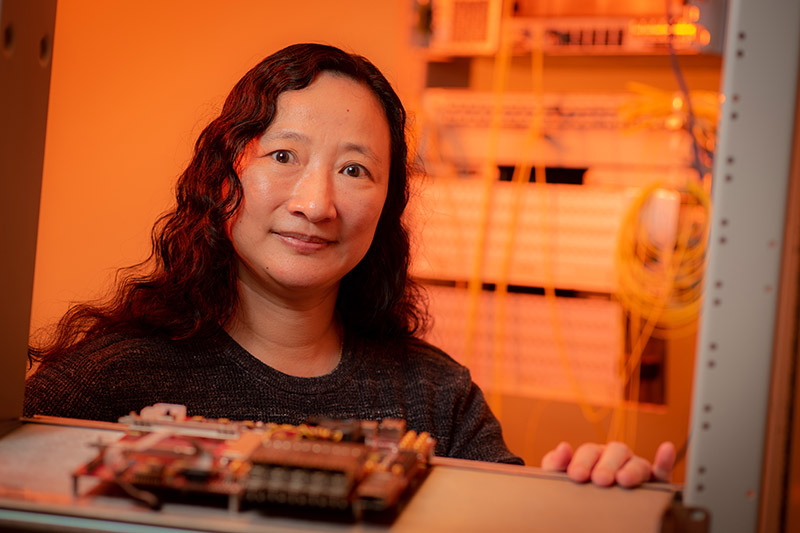
Electrical and computer engineering graduate students at the University of Houston have the opportunity to work with and learn from faculty recognized as world leaders in their fields. These include Fellows of the IEEE and the National Academy of Inventors, multiple NSF CAREER Award winners, and investigators in major research projects supported by NASA, DARPA, NIH, ARPA-E and the NSF.
ECE graduate students can also take full advantage of the college’s location in Houston. Many department researchers work closely with firms in the energy industry, allowing them to address the sector’s most pressing needs. Faculty also have ongoing collaborations with physicians and researchers at Texas Medical Center institutions, enabling them to bring advances from the lab to the clinic as quickly as possible.
Regardless of their career objectives — whether obtaining an R&D post in academia or expanding their skillset for work as a practicing engineer — students can take advantage of these opportunities thanks to the different degree plans offered by the department.
Doctor of Philosophy in Electrical Engineering (Ph.D.)
The Ph.D. is a research-intensive degree that prepares students for a research and development career in industry or academia. Given the research focus of the Ph.D., applicants must have a deep affinity for their research topic and be fully committed to completing their degree and contributing to their discipline.
There are two paths to the Ph.D.:
- Directly from B.S. to Ph.D., bypassing the M.S. degree, which is recommended for motivated, top-performing candidates with a clear idea of what they want to accomplish in their field of study.
- Obtaining a M.S. degree (at UH or elsewhere) prior to Ph.D. studies. This is recommended for students who are still forming a clear vision of their future career objectives.
Doctor of Philosophy in Computer Engineering (Ph.D.)
The Computer Engineering Ph.D. program will provide students with a doctoral-level education in Computer Engineering in preparation for successful academic, national laboratory, or industrial research and development careers in computer software and hardware. The Ph.D. program will be administered as a graduate research program within the Cullen College of Engineering’s Department of Electrical and Computer Engineering (ECE).
There are two paths to enter this Ph.D. program:
- Directly from B.S. to Ph.D., bypassing M.S. Degree, which is recommended for motivated, top-performing candidates with a clear idea of what they want to accomplish in their field of study
- Obtaining an M.S. degree ( at UH or elsewhere) prior to Ph.D. studies. This pathway is recommended for students who are still forming a clear vision of their future career objectives.
Click here to learn more about our new Computer Engineering Ph.D. program!
Master of Science in Electrical Engineering (MSEE, Thesis option)
The Master of Science in Electrical Engineering (MSEE) thesis program is a research-oriented program and requires the completion of a thesis that describes the results of research conducted under the guidance of a faculty advisor. This is a good option for students who would like to have some research experience as part of their MSEE program, either to help lead them into the PhD program, or because they simply want to have research experience to add to their resume. The program is a 30 hour program, requiring 18 hours in coursework and 12 hours in research and thesis classes. Student in this program should select an advisor as soon as possible, ideally prior to beginning the program.
Master of Science in Electrical Engineering (MSEE, Non-thesis option)
The Master of Science in Electrical Engineering (MSEE) non-thesis program provides advanced instruction in one or more specialized areas, making it well suited for students who want to grow their knowledge and skillset beyond the undergraduate level, but who are not interested in having a research component of their Masters program. However, students who pursue the non-thesis MSEE degree are still equally able to apply to enter the PhD program as students who follow the MSEE thesis program.
In this program student specialize in one of 10 areas of ECE (please see the Degree Requirements webpage for more details about these areas). Students in this program are required to choose 18 hours of courses in their specialization and 12 hours of general elective and breadth courses. This gives students the flexibility to pursue coursework in one or more secondary areas of interest to them. Options include courses in other Engineering departments, the College of Business Administration, and the College of Natural Sciences and Mathematics. This flexibility allows students to design a degree program that best matches their goals for the future.
The thesis and non-thesis programs are open to both part-time and full-time students. Students who do not wish to pursue a degree can take individual classes as a Non-Degree Objective (NDO) student.
Master of Computer and Systems Engineering (MSCSE)
The Computer and Systems Engineering (CSE) degree is a graduate level, interdisciplinary program administered by the Department of Electrical and Computer Engineering that provides specialization in Computer Engineering.
Applicants can have a B.S. in any one of the following fields: Electrical Engineering, Computer Engineering, Computer Science or a degree in any engineering field or Quantitative Science. Depending on previous background, a set of prerequisites might have to be satisfied before the student starts the graduate program in CSE. A student can complete the degree on a full or part time basis and has the option of doing a thesis or not. A full description of the CSE Program Requirements can be found here.
Detailed information on the application process can be found in the Application Procedures section of the website.
Prospective students can get academic advising from zhan2 [at] central.uh.edu (Dr. Zhu Han) by making an appointment or contact the Graduate Admissions Advisor at ece_grad_admit [at] uh.edu (ECE_Grad_Admit[at]uh[dot]edu).

Accelerated Master’s Program
With fast track admissions, Cullen College of Engineering undergraduate students are able to pursue a Master’s degree by taking up to two graduate courses in their undergraduate program that can be used toward both degrees.
Online MS in Electrical Engineering
UH ECE now offers a completely online master's program in power and energy systems specialization through UH-Extend. Click here to learn more.